Can a jaw crusher handle reinforced concrete with rebar?
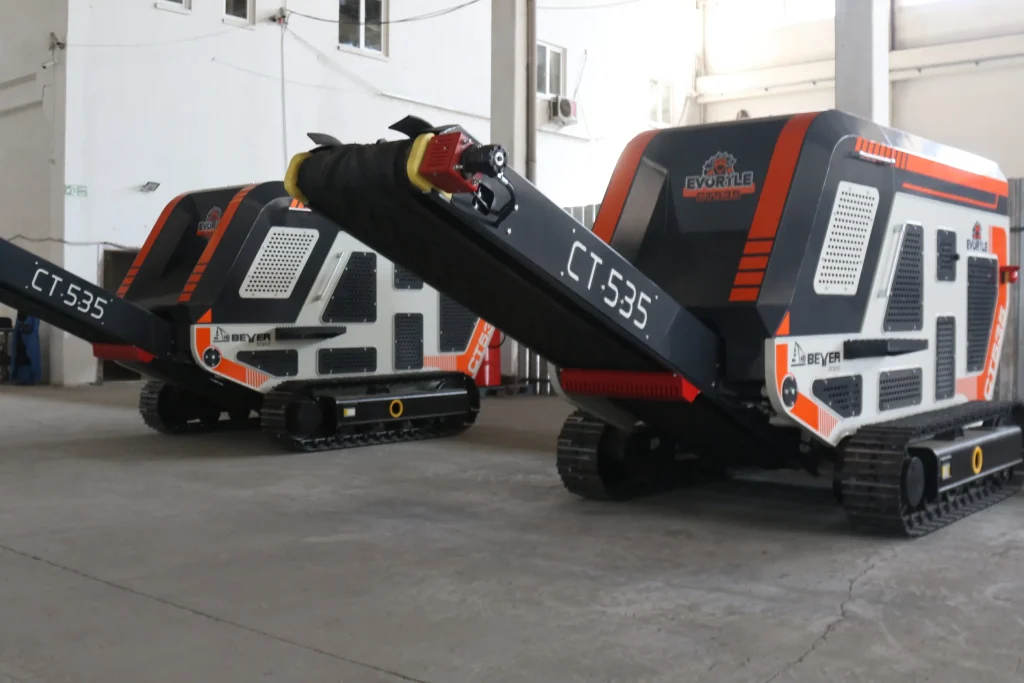
Yes. Reinforced concrete is the primary application for the Evortle CT-740 and CT-850. Rebar passes through the jaw crushing chamber without wrapping around the jaw mechanism. The integrated cross-belt magnet on the CT-740 and CT-850 separates ferrous material from the discharge belt automatically — you do not need to sort material before feeding or pick rebar from the output. The CT-535 handles reinforced concrete with the optional cross-belt magnet (+$7,000).
What output sizes does crushed concrete come in?
Output size is determined by the closed-side setting (CSS), which adjusts hydraulically on all three CT models. At 0-50mm CSS, output is road base and structural fill grade. At wider settings, output is a coarser scalping fraction. Paired with a CD-410 or CD-516 vibratory screening plant, the crushed output separates into three fractions — fines, middles, and overs — each in a different size class with different applications.
What is recycled concrete aggregate (RCA) used for?
At 0-50mm output, RCA meets the gradation for road base and structural fill in most state DOT specifications. Common applications include road base and sub-base, structural fill behind retaining walls, parking lot base course, pipe trench bedding, and drainage aggregate. In some state specifications, RCA is accepted as a partial replacement for virgin aggregate in concrete production. Output from a screening plant — sorted into three fractions — has more specific applications and typically commands better per-ton value than a single unsorted pile.
How much does it cost to crush concrete on-site?
Operating cost runs approximately $4.50 to $7.00 per ton all-in at typical commercial volumes, including fuel, one operator, wear parts, and equipment amortization on a 5-year straight-line basis. The per-ton cost drops as volume increases — the fixed amortization component spreads across more tons the more the machine runs. Use the calculator above with your actual disposal rate and volume to see net value per ton for your operation.
Do I need a screening plant with my jaw crusher?
It depends on what you are doing with the output. The jaw crusher alone produces a single crushed fraction at whatever CSS you set — usable as road base or structural fill without further processing. If you have a buyer for graded aggregate, a DOT spec to meet, or a job that needs separated fractions, you need a screening plant. The full circuit — crusher plus screening plant — is the setup that eliminates both the disposal cost and the aggregate purchase on the same project.
How many tons per hour can the CT-850 process?
The CT-850 processes 65 tons per hour at 0-50mm CSS and up to 95 tons per hour at a wider CSS setting (0-110mm). Over an 8-hour shift at 65 t/h, that is 520 tons of processed concrete. The CT-740 processes 45 to 55 tons per hour at 0-50mm. The CT-535 processes 20 tons per hour at 0-50mm.
What is the difference between a jaw crusher and an impact crusher for concrete recycling?
The critical difference is rebar handling. Impact crusher blow bars wrap on rebar — stopping the machine to clear a rotor is a regular event on reinforced concrete work. Jaw crushers compress material between two plates and rebar passes through without wrapping. The cross-belt magnet on the CT-740 and CT-850 then separates it from the discharge belt automatically. Impact crushers produce a more cubical output that is preferable for asphalt aggregate and high-specification concrete production. Jaw crusher output meets road base and structural fill specifications for most C&D recycling applications. For reinforced concrete work specifically, a jaw crusher is the lower-maintenance, lower-wear-cost choice.
Can I crush cinder blocks and masonry in a jaw crusher?
Yes. Cinder block, brick, and masonry process well in all three CT models. Masonry is softer than reinforced concrete and does not present the same rebar complication. The CT-535 handles cinder block and masonry at 20 tons per hour with smaller feed sizes. The CT-740 and CT-850 handle any masonry feed that fits the jaw opening. Output from crushed masonry is usable as structural fill and drainage aggregate.