
SINCE 1973
SINCE 1973
Pre-mixed topdressing sand arrives on someone else’s schedule at someone else’s blend ratio. The Screen USA Golf Course Blender loads two materials into two independent hoppers, sets the blend ratio, and discharges blended material directly into topdressing equipment or trucks at up to 1,000 tons per hour. Greens construction, fairway renovation, bunker renovation, and sports turf rootzone work — one machine handles the full blending operation on-site.
Ships same or next day
Not a call center
Included with every machine
Insured, on-call
The first problem is timing. A greens renovation or new construction project needs a consistent, high-volume supply of blended topdressing material. Delivered pre-mix moves on a supplier’s schedule, a trucking schedule, and weather. A renovation project waiting on sand trucks is paying crew and equipment to stand by.
The second problem is consistency. When topdressing material comes from an outside supplier, blend ratio is whatever the supplier produced for that batch. Greens rootzone mix — sand-to-amendment ratio, gradation, organic percentage — affects long-term drainage, aeration, and turf performance. Adjusting the blend mid-project means renegotiating with a supplier who may or may not accommodate the change.
On-site blending with the Screen USA Golf Course Blender solves both problems. Two hoppers, fed independently by wheel loaders, hold two materials. Feed rate on each hopper controls the blend ratio. Change it on the next load. Hold it the same across the entire project. Discharge conveyor puts blended material directly into spreader trucks or topdressing equipment at up to 1,000 tons per hour — no secondary handling, no waiting on deliveries, no batch-to-batch inconsistency from an outside source.
How It Works
The Golf Course Blender operates as a two-hopper continuous blending system. One machine, two material streams, consistent output from start to finish.
A wheel loader loads Hopper 1 (15 cubic yards) with the primary material — typically USGA-grade construction sand or topdressing sand. Hopper 2 (13 cubic yards) receives the secondary material — organic amendment, calcined clay, a second sand grade, or any dry granular amendment at the required percentage. While one hopper runs, the loader refills the other.
Each hopper feeds material onto the discharge conveyor at an independently controlled rate. The ratio between Hopper 1 and Hopper 2 feed rates determines the output blend percentage. Set the ratio once for the project specification — the machine holds it consistently from load to load. Adjust it for the next phase if the specification changes.
Both material streams deposit onto the 48″ discharge conveyor simultaneously. The conveyor carries combined material from the hopper zone to the discharge point. By the discharge end, the two streams are uniformly combined. No separate mixing drum, no paddle mixer, no additional equipment required.
The discharge conveyor measures 48″ wide and 30′ long, with a 15’6″ discharge height. That height loads directly into a standard dump truck bed or a sand topdressing trailer without a transfer conveyor. At up to 1,000 TPH, the GCB keeps the loading cycle ahead of a truck fleet.
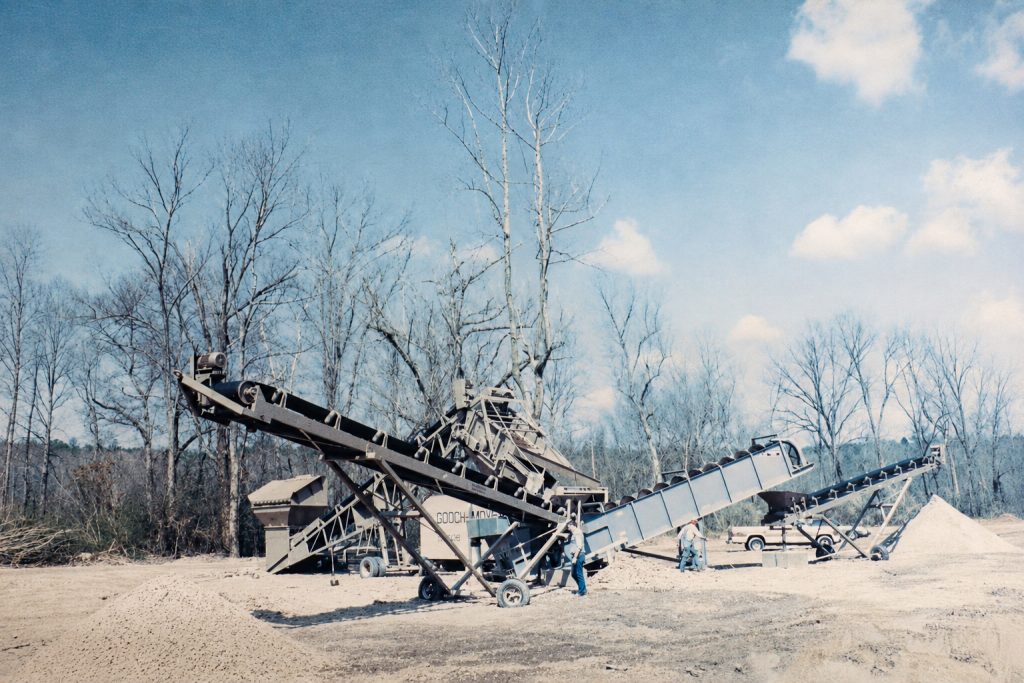
The Screen USA Golf Course Blender is the right machine for specific project types and operation scales. It is not the right tool for small maintenance topdressing that pre-mixed delivered material handles efficiently.
Not sure which way your project falls? Call 770-433-2670. We will tell you honestly whether the GCB is the right fit for your volume, your timeline, and your specification.
The GCB produces blended two-component material. Output quality and specification compliance depend entirely on the input materials — the GCB blends at ratio. If the inputs meet the required specification, the output will meet it consistently.
USGA method greens construction specifies a primary root zone layer of sand-dominant mix with a defined organic content percentage. Hopper 1 holds USGA-grade construction sand. Hopper 2 holds the organic amendment at the specified inclusion percentage. GCB blends at the set ratio across the entire greens construction volume. USGA-grade output requires USGA-grade input.
Support
Mixed demolition debris is the CT-740 and CT-850’s application — the 28-inch and 32-inch jaw openings handle the feed size variation that comes with building teardowns and mixed demolition loads. The CT-535 handles light mixed masonry and concrete but is not the right machine for full commercial C&D processing volume or feed size.
Volume. A greens renovation on an 18-hole course can require 1,000 to 4,000+ tons of rootzone mix depending on depth and renovation scope. At that volume, pre-mixed delivery requires sustained trucking coordination over days or weeks. The GCB at 1,000 TPH capacity can supply that volume in a single production day with continuous loader cycling. The bottleneck shifts from material supply to placement capacity.
Schedule control. A renovation project with a fixed reopening deadline has no margin for delivery delays. Truck availability, supplier production scheduling, and weather all affect pre-mixed delivery timelines. On-site blending eliminates those variables.
Blend ratio flexibility. Greens rootzone, tee box construction, and fairway topdressing applications within the same project often require different blend ratios of the same input materials. With the GCB, each phase uses a different feed rate setting on the same two stockpiled inputs.
Quality verification at the point of production. When you control the blend on-site, you know what went in. You can verify input material gradation before it goes into the hopper.
Routine maintenance topdressing at maintenance rates. Annual or seasonal topdressing on established greens at maintenance rates — light sand application over existing turf — involves volumes that trucked pre-mix handles without difficulty. No production equipment required.
Projects without on-site material storage. If the project site has no area to stockpile two input materials separately, on-site blending requires storage logistics that may not be practical. Pre-mixed delivery eliminates the stockpile requirement.
Pre-sort quality. The cleaner the feed going into the jaw, the better the output coming out. Mixed C&D with drywall contamination produces gypsum in the fines fraction that degrades structural fill quality. Plastics in the feed show up in the output. The jaw crusher does not eliminate contamination — it crushes what you put into it.
Learn More About the LandBx →
App
Landscape contractors and topsoil producers separating raw excavated topsoil into screened, sellable product. CZ electric trommel screens starting at $38,900 and the Screen USA CD-410 vibratory screening plant.
App
App
Jaw crushers for hard rock — limestone, granite, basalt — paired with vibratory screening plants for aggregate production. For quarry operators and contractors processing blasted rock into sized aggregate.
App
The GCB blends at a controlled ratio — it does not change the physical properties of the materials loaded into it. If Hopper 1 contains USGA-grade construction sand at the specified gradation and Hopper 2 contains the correct organic amendment at the required inclusion percentage, the output will meet USGA specification for that blend. If input materials do not meet the required gradation or quality standard, the output will not meet USGA spec regardless of blend ratio. The GCB is the production tool. Material sourcing and gradation verification happen before material goes into the hopper.
Contact
Monday–Friday, 8am–5pm ET
Response Time
Same business day on calls and form submissions received before 3pm ET.
What to Have Ready
Project type, number of holes or field size, estimated volume in tons, and your project timeline.
Headquarters