Screen USA — Applications — C&D Recycling

On-Site Concrete Recycling: From C&D Debris to Road Base and Sellable Aggregate

Demolished concrete, cinder block, masonry, and mixed C&D debris costs $45 to $120 per ton to haul. An Evortle jaw crusher paired with a Screen USA vibratory screening plant turns it into road base, structural fill, and sellable aggregate on-site. Three crusher models. Two screening plants. Full circuits starting at $356,800.
$45–$120/ton
Tipping fee eliminated on C&D concrete and masonry
500M+ tons
C&D debris generated in the US annually
3 streams
Processed with one jaw crusher circuit: concrete, masonry, mixed C&D

Parts stocked in Smyrna, GA

Ships same or next day

Direct engineer support

Not a call center

On-site setup & training

Included with every machine

Nationwide field technicians

Insured, on-call

The Problem

C&D Debris Is Your Largest Disposal Cost — and Your Most Overlooked Material Opportunity

Demolished concrete makes up roughly 85% of construction and demolition waste by weight. Add cinder block, brick, and mixed masonry and you have a material stream that accounts for the majority of disposal volume on commercial demolition and site development projects.

Every ton of that material that leaves the site costs money twice. First, you pay to haul it: trucking plus tipping fees run $45 to $120 per ton depending on your market and the receiving facility. Second, you pay to bring aggregate back in for the next phase of work: road base, structural fill, sub-base material, pipe bedding — all purchased new at $15 to $30 per ton.

At 300 tons of demolished concrete on a standard commercial project, that gap — disposal cost plus replacement aggregate cost — runs $18,000 to $45,000. On a demolition yard handling thousands of tons per month, it is the difference between a profitable material stream and a cost center. The jaw crusher and screening plant circuit eliminates both sides of the equation.

Hauling Away
Crushing On-Site
Hauling AwayPay $45–$120/ton tipping fee
Crushing On-SiteEliminate the tipping fee
Hauling AwayPay trucking on top
Crushing On-SiteNo haul-out required
Hauling AwayBuy road base and structural fill for next phase
Crushing On-SiteCrushed output is the road base and fill
Hauling AwayDisposal cost multiplies with project volume
Crushing On-SiteOperating cost drops per ton as volume increases
Hauling AwayConcrete, masonry, and C&D waste — three separate problems
Crushing On-SiteSame circuit handles all three
How It Works

How On-Site C&D Recycling Works

An Evortle jaw crusher and Screen USA vibratory screening plant are the two-machine circuit that handles every concrete, masonry, and mixed C&D waste application in the lineup. Both machines are diesel, mobile, and self-contained. The full circuit fits on two lowboys.
01

Load

Load demolished concrete, cinder block, masonry, or mixed demolition debris into the jaw crusher’s hopper with an excavator or wheel loader. Max feed size is 20 inches on the CT-535, 28 inches on the CT-740, and 32 inches on the CT-850. Most commercial demolition material — full-depth reinforced slabs, cinder block walls, masonry foundations — feeds directly without pre-breaking on the CT-740 or CT-850.
02

Crush

Feed material enters the jaw chamber and compresses between two manganese-steel jaw plates. The moving jaw swings in an elliptical arc, applying progressive force to fracture material downward. Closed-side setting adjusts hydraulically from the wireless remote — no manual shimming, no stopping the machine to change output size. Rebar in reinforced concrete bends and passes through the jaw chamber without wrapping on the mechanism.
03

Screen

Crushed material from the jaw discharge feeds directly into the CD-410 or CD-516 vibratory screening plant. The 2-deck screen sorts material into three fractions in a single pass — overs, middles, and fines — each stockpiled by a dedicated built-on conveyor at a separate point around the machine.
04

Stockpile and Reuse

Each fraction has specific applications: fines as sub-base and compactable fill, middles as road base and drainage aggregate, overs returned for re-crushing or stockpiled as large drainage rock. The cross-belt magnet on the CT-740 and CT-850 separates rebar from the discharge belt automatically — ferrous scrap is a separate pile beside the machine.
Equipment

Choose Your Recycling Circuit

Five machines make up the C&D recycling lineup. Select the crusher that matches your volume and feed size, pair it with the matching screening plant.
Jaw Crushers — Evortle CT Series

Entry Level

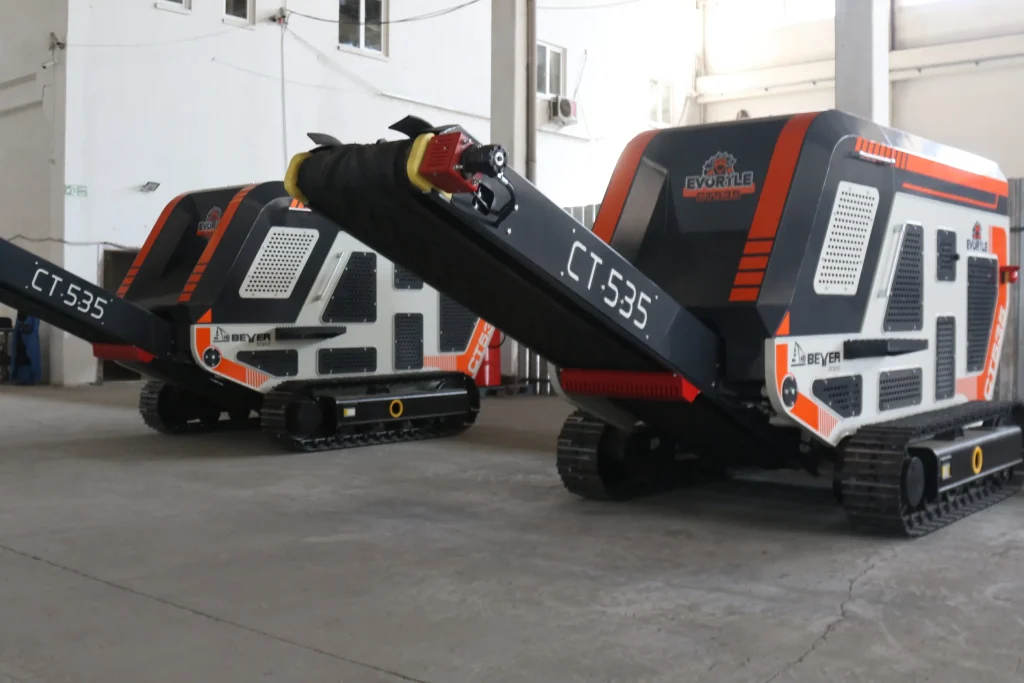
CT-535

$156,900
20 t/h at 0-50mm  |  20″ max feed  |  74 HP Hatz Tier 4  |  14,331 lbs
The entry-level crusher for residential demolition, light commercial, and small concrete removal projects. Concrete, cinder block, brick, and masonry all feed through the CT-535. Soft rock and limestone capable. Not rated for hard rock. Cross-belt magnet optional (+$7,000) — required for reinforced concrete work.
Choose the CT-535 if: Residential demolition or light commercial projects. Feed under 20 inches. Throughput at 20 t/h keeps up with your equipment. Budget is the primary constraint.
Most Popular

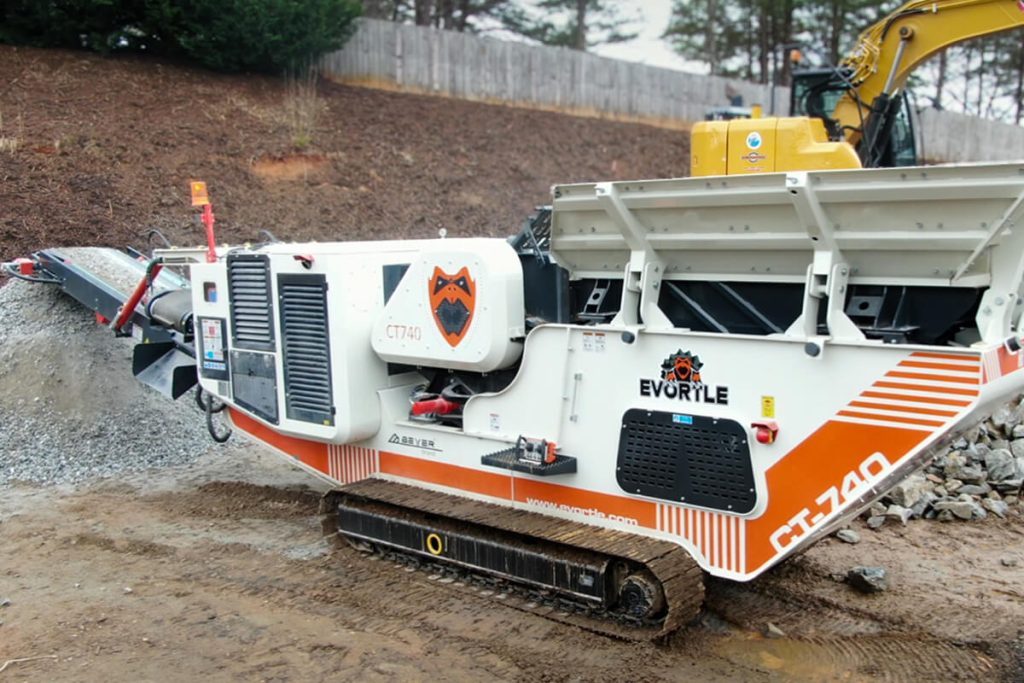
CT-740

$326,000
45–55 t/h at 0-50mm  |  28″ max feed  |  134–140 HP Perkins or Yanmar  |  38,600 lbs
The primary machine for commercial demolition contractors and C&D processors. The 28-inch jaw opening accepts full-depth reinforced slabs, columns, and foundation sections without pre-breaking. Intelligent level control included. Cross-belt magnet included. Hard rock capable.
Choose the CT-740 if: Commercial demolition at 100–500 tons per project. Feed regularly over 20 inches. Hard rock capability required or preferred.
Production Volume

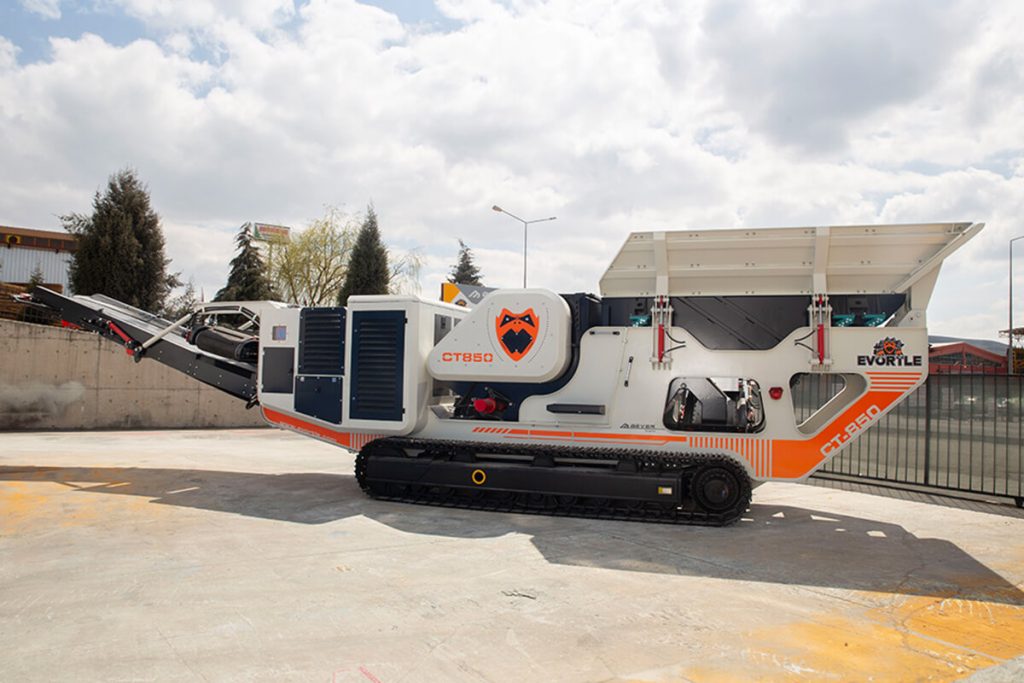
CT-850

$426,000
65–95 t/h  |  32″ max feed  |  150 HP Cat or Perkins Tier 4 Final  |  56,000 lbs
For demolition yards, large-scale C&D processing facilities, and high-volume site contractors. The widest jaw opening in the CT series. By-pass conveyor included. Cross-belt magnet included. Hard rock at production volume above 55 t/h.
Choose the CT-850 if: Sustained high-volume operation. Demolition yard or C&D processing facility. Production throughput above 55 t/h required.
Vibratory Screening Plants — Screen USA CD Series

Pairs with CT-535 and CT-740

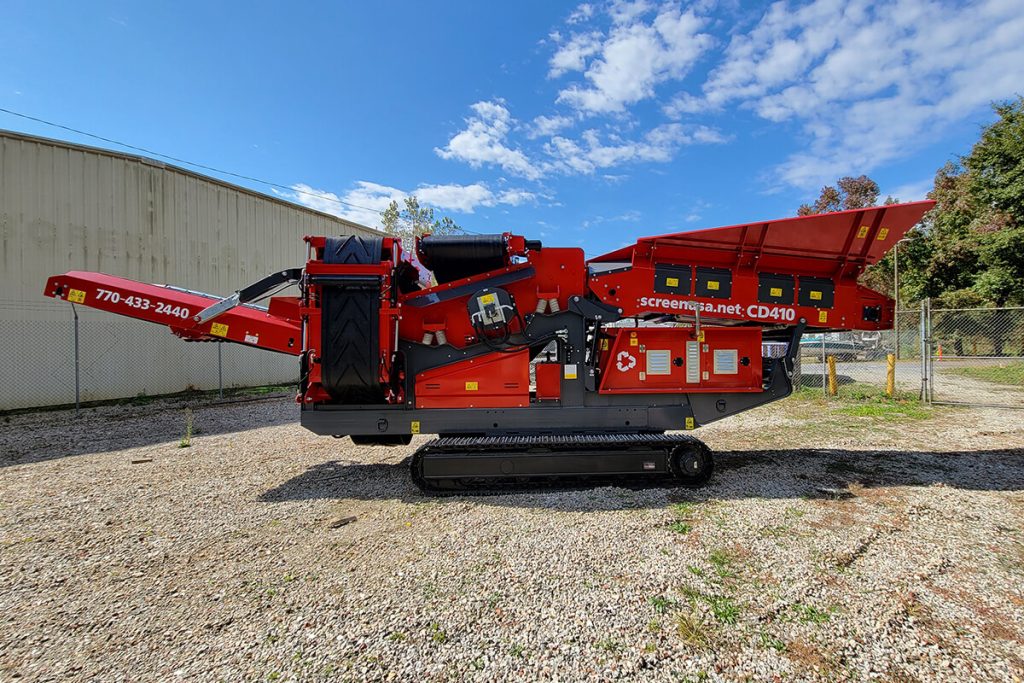
CD-410

$199,900
2-deck, 4 ft. x 10 ft.  |  5.5 cu.yd. hopper  |  74 HP Cat C2.2 Tier 4 Final  |  32,000 lbs
Sorts crusher discharge into three fractions in a single pass with three built-on stockpiling conveyors. Right-sized for commercial demolition volume up to the CT-740’s output capacity.
Pairs with CT-850

CD-516

$389,900
2-deck, 5 ft. x 16 ft.  |  18 cu.yd. hopper  |  145 HP Cat C4.4 Tier 4 Final  |  71,651 lbs
The 18 cubic yard hopper and larger screen area match the CT-850’s production discharge volume. For demolition yards and C&D processing facilities running thousands of tons per month, the CD-516 keeps up with the CT-850 without becoming the throughput constraint.
Full Circuit Pricing
Crusher
Throughput
Screening Plant
Full Circuit Price
CrusherCT-535
Throughput20 t/h
Screening PlantCD-410
Full Circuit Price$356,800
CrusherCT-740
Throughput45–55 t/h
Screening PlantCD-410
Full Circuit Price$525,900
CrusherCT-740
Throughput45–55 t/h
Screening PlantCD-516
Full Circuit Price$715,900
CrusherCT-850
Throughput65–95 t/h
Screening PlantCD-516
Full Circuit Price$815,900
Prices as of August 2026. Subject to change. Screen media aperture sizes are specified per application based on your target output gradation — call 770-433-2670.
What Material Are You Processing?
Sub-Page

Primarily Concrete

Slabs, columns, foundations, footings, reinforced structures. Full guide to rebar handling, RCA output and market applications, jaw vs. impact crusher comparison, and a concrete-specific ROI calculator.
Concrete Recycling →
Sub-Page

Primarily Cinder Block and Masonry

CMU walls, block foundations, brick demolition. Machine selection, feed considerations, and output applications for recycled masonry aggregate.
Cinder Block and Masonry →
Sub-Page

Mixed C&D Debris

Concrete, masonry, and demolition rubble in combination. Feed management, contamination sorting, and circuit setup for mixed material streams.
C&D Waste Processing →

Calculate Your C&D Recycling ROI

Disposal costs and RCA pricing vary by region. The defaults below are national benchmarks — adjust every number to match what you are actually paying and receiving in your market. Concrete is the default material; operating costs per ton are similar for cinder block and masonry at equivalent throughput.
Your Operation
Volume of C&D material per year (tons) 1,500
Primary material
Crusher model
What will you do with the recycled output?
RCA sell price per ton $20
Costs and Rates
Tipping fee per ton $65
Trucking cost per ton $8
Operating hours per day 8
Diesel price per gallon $4.25
Operator rate per hour ($)
Estimated annual net value
$0
Disposal cost avoided
$0
Annual crushing cost
$0
RCA revenue
$0
Calculating...

These are estimates based on your inputs and national benchmarks. Results vary by region, material type, and job conditions. Call us for a quote built around your actual numbers.

Get a Site-Specific Quote
Pairing Guide

Match the Circuit to the Job

The right circuit depends on your primary material, your feed size, and your throughput requirement. Every circuit is two machines — one jaw crusher and one vibratory screening plant.
Job Type
Primary Material
Feed Size
Crusher
Screen
Circuit Price
Job TypeResidential / light commercial
Primary MaterialConcrete, masonry, cinder block
Feed SizeUnder 20"
CrusherCT-535
ScreenCD-410
Circuit Price$356,800
Job TypeCommercial demolition
Primary MaterialReinforced concrete, hard rock
Feed SizeUp to 28"
CrusherCT-740
ScreenCD-410
Circuit Price$525,900
Job TypeCommercial, higher output
Primary MaterialReinforced concrete, hard rock
Feed SizeUp to 28"
CrusherCT-740
ScreenCD-516
Circuit Price$715,900
Job TypeProduction demolition yard
Primary MaterialConcrete, hard rock, mixed C&D
Feed SizeUp to 32"
CrusherCT-850
ScreenCD-516
Circuit Price$815,900
Screen media aperture sizes are specified per application based on your target output gradation. We spec the right media for your material and intended use. Call 770-433-2670.
Output Guide

What the Circuit Produces

The jaw crusher and screening plant circuit produces three separated fractions from demolished concrete, masonry, and C&D debris — plus a ferrous scrap pile on CT-740 and CT-850 circuits.
Fines — Below bottom deck

Structural Fill and Sub-Base

Typically 0–10mm. Compactable structural fill, sub-base under concrete pours, grading fill. On most commercial demolition projects, the fines fraction from the crushed slab goes under the new slab — material that would have been purchased as sub-base is produced from what was a disposal cost.
Middles — Between decks

Road Base and Drainage Aggregate

Mid-range gradation. Road base, drainage aggregate, pipe trench bedding, parking lot sub-base. The middles fraction typically commands the highest per-ton value when sold because it meets the most common graded aggregate specifications.
Overs — Above top deck

Re-Crush or Large Drainage Rock

Returned to the crusher for a second pass, or stockpiled as large drainage rock. On a well-set circuit processing concrete and masonry, the overs fraction is minimal.
CT-740 and CT-850 only

Rebar — Ferrous Scrap

Cross-belt magnet separates rebar from the discharge belt automatically. Rebar bends and passes through the jaw chamber, exits on the discharge belt, and the magnet pulls it off. The rebar pile beside the machine is ferrous scrap at current market rates — typically $100 to $200 per ton.
Crushed Concrete Road Base (0-50mm)
$10–$20/ton
Market estimate — varies by region and DOT acceptance
Structural Fill
$8–$15/ton
Private site work — not DOT bid work
Crushed Masonry Road Base
$8–$15/ton
Market estimate as of August 2026
Ferrous Scrap (Rebar)
$100–$200/ton
CT-740 and CT-850 circuits only. Market rate.
Pricing varies significantly by region and DOT specification acceptance. These are market estimates, not guaranteed prices. For concrete-specific RCA output applications and state DOT spec guidance, see the Concrete Recycling page.
Support

Parts in Stock. Engineers on Call. No Overseas Wait.

Every machine we sell is backed by US-stocked parts out of our Smyrna, Georgia facility. Not a backorder form. Not a six-week lead time from a factory in another country. When something needs replacing, we ship it.

US Parts Inventory

Common wear parts — jaw plates, conveyor belts, hydraulic components, screen media — stocked in Smyrna, GA. Ships same or next day.

Direct Engineer Access

When you call, you reach someone who knows the machine. Not a ticketing system. Not a callback queue. A person, on the phone, who can diagnose the issue and tell you what you need.

On-Site Setup and Training

We come to your yard. We run the machine with your crew. We do not leave until it is running right and your operators know what they are doing.

Nationwide Field Technicians

A network of insured field technicians across the US. If the problem cannot be solved over the phone, we put someone on it.

Since 1973 — 50+ years of knowing exactly what breaks and exactly how to fix it.

When It Makes Sense

When On-Site Recycling Makes Sense — and When It Does Not

When On-Site Recycling Clearly Makes Sense

Volume above 100 tons at a single site. At volumes above 100 tons, the operating cost of crushing — approximately $4 to $7 per ton all-in on a jaw crusher circuit — is well below the tipping fee it replaces. The more tons you process, the lower the per-ton cost, as the fixed amortization component spreads over more material.
Material type: concrete, masonry, cinder block. Reinforced concrete processes cleanly — rebar passes through the jaw chamber and is separated by the cross-belt magnet. Cinder block and masonry process without rebar complications. Mixed C&D that is primarily concrete and masonry by weight feeds well on a CT-740 or CT-850.
On-site aggregate reuse. When the crushed output has a direct use on the same project — road base for the access road, structural fill for the next phase of work, sub-base under a new slab — the full value is captured without transportation.

When Hauling May Still Make More Sense

Small volume on a constrained site. Below 50 tons, mobilizing a jaw crusher and screening plant may not be economical relative to a direct haul. Below 100 tons is a grey zone — use the calculator above with your actual disposal rate to check the math.
Heavily contaminated C&D streams. A jaw crusher processes concrete, masonry, and hard rock. It does not handle drywall, treated lumber, plastics, roofing material, insulation, or hazardous waste — none of these are jaw crusher feed materials. If your C&D stream is heavily mixed with these materials, pre-sorting is required before feeding the crusher.
Asphalt-heavy demolition. The CT-series jaw crushers are not rated for asphalt. If your demolition project generates primarily asphalt millings or pavement, call us and we will walk through what the circuit looks like for your specific mix.
Several states have enacted C&D landfill diversion requirements or are actively tightening C&D disposal access. California, Massachusetts, Oregon, and Washington have the most developed C&D diversion programs. Tipping fees have trended upward as landfill capacity tightens — the per-ton math on on-site recycling improves as tipping fees rise.
FyreBx

Keep the Operation Running

FyreBx — LandBx

Dust Suppression at the Crusher

Concrete fines at the jaw discharge generate silica dust — OSHA-regulated under 29 CFR 1926.1153 at construction sites. The LandBx mounts to any skid steer and delivers 5 to 250 GPM of water suppression directly at the crusher discharge and stockpile zone. No water truck. No separate dust rig.
FyreBx — LandBx

End-of-Shift Equipment Washing

Concrete fines and clay set on jaw plates, the discharge conveyor, the magnet housing, and vibratory screen decks between shifts. Buildup accelerates wear and reduces throughput. The LandBx delivers high-volume wash water to clear buildup before it hardens — extending wear part life between replacements.
FyreBx — FuelBx

On-Site Diesel Refueling

A full C&D recycling circuit — jaw crusher plus screening plant — burns diesel across two machines through every shift. The FuelBx carries 300 gallons of diesel on the front of a skid steer and delivers it through a 50-foot hose reel. No fuel truck scheduling. No machines sitting idle waiting on a delivery.
What Are You Processing?

Go Deeper by Material

Recycling — Sub-Page

Concrete Recycling

Reinforced concrete slabs, footings, columns, and foundations. Full guide to rebar handling, RCA output and market applications, jaw vs. impact crusher comparison, and a concrete-specific ROI calculator.
Concrete Recycling →
Recycling — Sub-Page

Cinder Block and Masonry

Cinder block walls, brick, masonry block, and CMU. Machine selection, feed considerations, and output applications for recycled masonry aggregate.

Cinder Block and Masonry →
Recycling — Sub-Page

C&D Waste Processing

Mixed demolition debris — concrete, masonry, block, and demolition rubble in combination. Feed management, contamination sorting, and circuit setup for mixed C&D streams.

C&D Waste Processing →

Related Application

Natural Rock

Granite, limestone, basalt, and dolomite. The CT-740 and CT-850 handle natural rock applications as well as C&D material — same machines, different buyer.
Natural Rock →
FAQ

Common Questions About On-Site C&D Recycling

What materials can a jaw crusher recycle?

All three Evortle CT-series jaw crushers handle concrete, cinder block, brick, and masonry. The CT-740 and CT-850 also handle hard rock — granite, basalt, dolomite, and limestone. The CT-535 handles soft rock and limestone only, not hard rock. None of the CT-series jaw crushers are rated for asphalt. Drywall, treated lumber, plastics, insulation, and hazardous materials are not jaw crusher feed materials and require pre-sorting before the crusher.

What is the difference between the CT-535, CT-740, and CT-850?

The primary differences are jaw opening size, throughput, and hard rock capability. The CT-535 accepts material up to 20 inches and produces 20 tons per hour at 0-50mm output — rated for concrete, masonry, and soft rock. The CT-740 accepts up to 28 inches and produces 45 to 55 tons per hour — rated for concrete, masonry, and hard rock (granite, basalt, dolomite). The CT-850 accepts up to 32 inches and produces 65 to 95 tons per hour — same material capability as the CT-740 at higher throughput. The CT-740 includes intelligent level control (automatic feed rate regulation). The CT-850 includes a by-pass conveyor. Both the CT-740 and CT-850 include cross-belt magnets for rebar separation as standard.

Do I need permits to crush concrete on-site?

Permit requirements vary by state and local jurisdiction. Most states classify on-site concrete crushing as a standard construction activity that does not require a dedicated air or processing permit when the output is reused on the same project site. Some states require an air permit for dust-generating operations; silica dust at the crusher discharge is an OSHA-regulated exposure under 29 CFR 1926.1153 regardless of local permit requirements. Transporting crushed material off-site and selling it as aggregate may trigger additional requirements in some jurisdictions. Call us at 770-433-2670 — we work with contractors in every state and can point you toward the right framework for your region.

Can the same machine handle both concrete and cinder block?

Yes. All three CT-series jaw crushers handle concrete, cinder block, brick, and masonry. Cinder block is softer than reinforced concrete and feeds well in all three models. Masonry without rebar does not require a cross-belt magnet — the magnet is included on the CT-740 and CT-850 as standard, and available as an option on the CT-535 (+$7,000). For mixed feeds of reinforced concrete and masonry on the same site, add the magnet on the CT-535 and rely on the included magnet on the CT-740 and CT-850.

What is the minimum volume that makes on-site crushing worthwhile?

At typical tipping fees of $45 to $120 per ton, most contractors find on-site crushing makes financial sense above 100 tons per project or site. Below 50 tons, the mobilization cost of the crusher affects the per-ton math. Above 200 tons, the numbers favor on-site crushing in nearly every US market. For contractors running smaller jobs frequently — 50 to 80 tons per job, multiple projects per month within a working radius — the aggregate annual volume and equipment utilization changes the calculation. Use the calculator above with your actual disposal rate and volume.

Can crushed concrete be used as road base?

At 0-50mm output, crushed concrete meets the gradation for road base and structural fill in most state DOT programs. Acceptance varies by state — some DOTs have explicit specifications for recycled concrete aggregate (RCA) as base course; others accept it on a project-by-project basis. For DOT bid work, confirm local specification acceptance before including RCA in your plan. For private site work — access roads, parking lot base, sub-base under new slabs — crushed concrete at 0-50mm performs the same function as virgin aggregate in the same application.

What happens to the rebar from reinforced concrete?

On the CT-740 and CT-850, the cross-belt magnet separates rebar from the crusher discharge belt automatically during normal operation. Rebar bends and passes through the jaw chamber without wrapping on the jaw mechanism — it exits on the discharge belt and the magnet pulls it off. The rebar pile beside the machine is ferrous scrap at current market rates — typically $100 to $200 per ton depending on your market. On the CT-535, the cross-belt magnet is an optional add-on (+$7,000). For reinforced concrete work on a CT-535, the magnet is the right call.

Does Screen USA offer financing or rental for jaw crushers?

Call us at 770-433-2670 to discuss financing options. For rental, Screen USA maintains a rental directory of Evortle CT-series jaw crushers available through authorized dealers. Some buyers rent for a single high-volume project before committing to a purchase; others need short-term capacity without the capital requirement. We will point you to the right option for your situation.
Contact

Tell us about your demolition or recycling operation.


Call Direct
770-433-2670
Monday–Friday, 8am–5pm ET
Response Time
Same business day on calls and form submissions received before 3pm ET.
What to Have Ready
Material type, tons per month or per project, current disposal cost, and whether you need fractionated output or single-fraction road base.
Rental Directory
View the CT-series rental directory if you need short-term capacity before committing to a purchase.