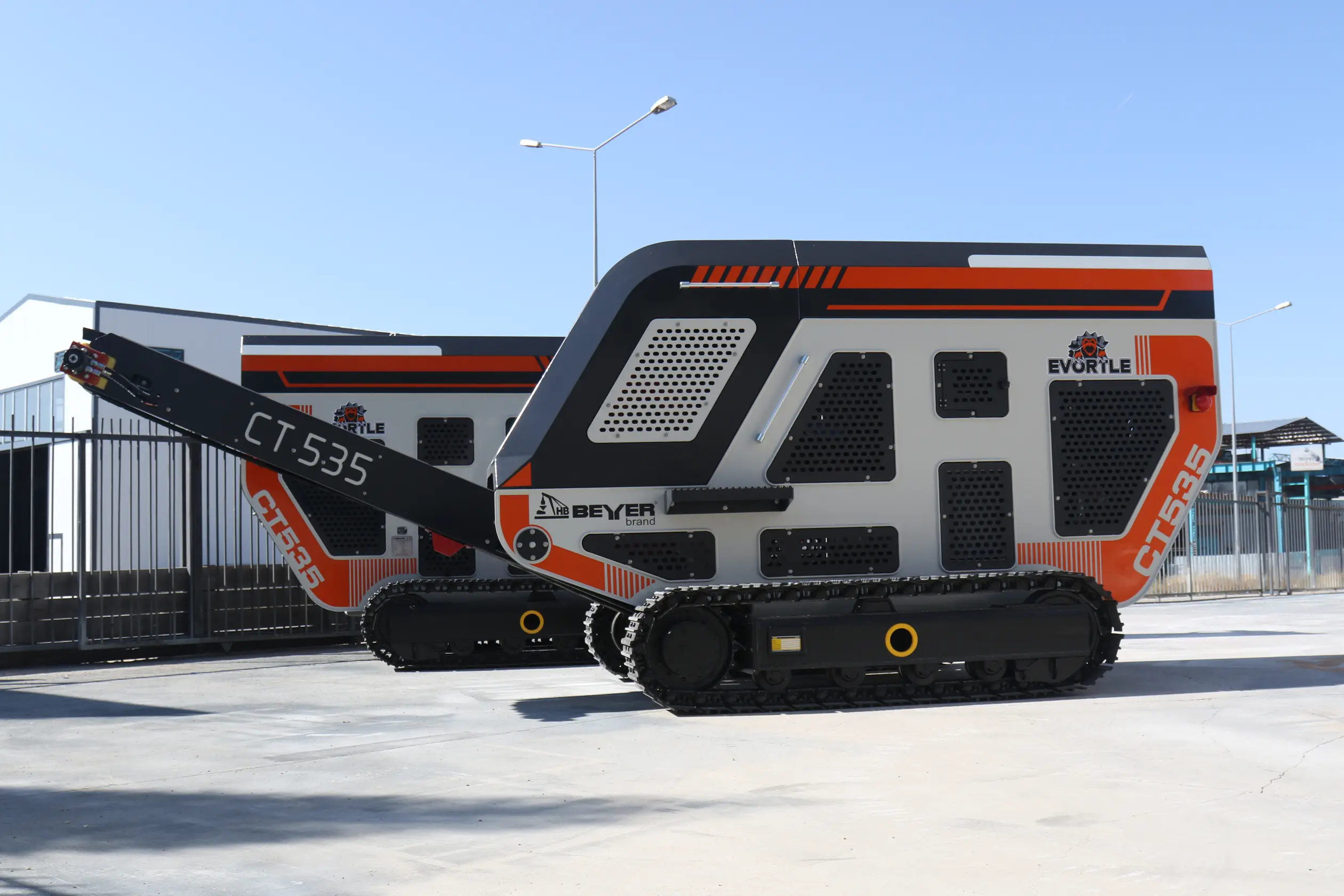
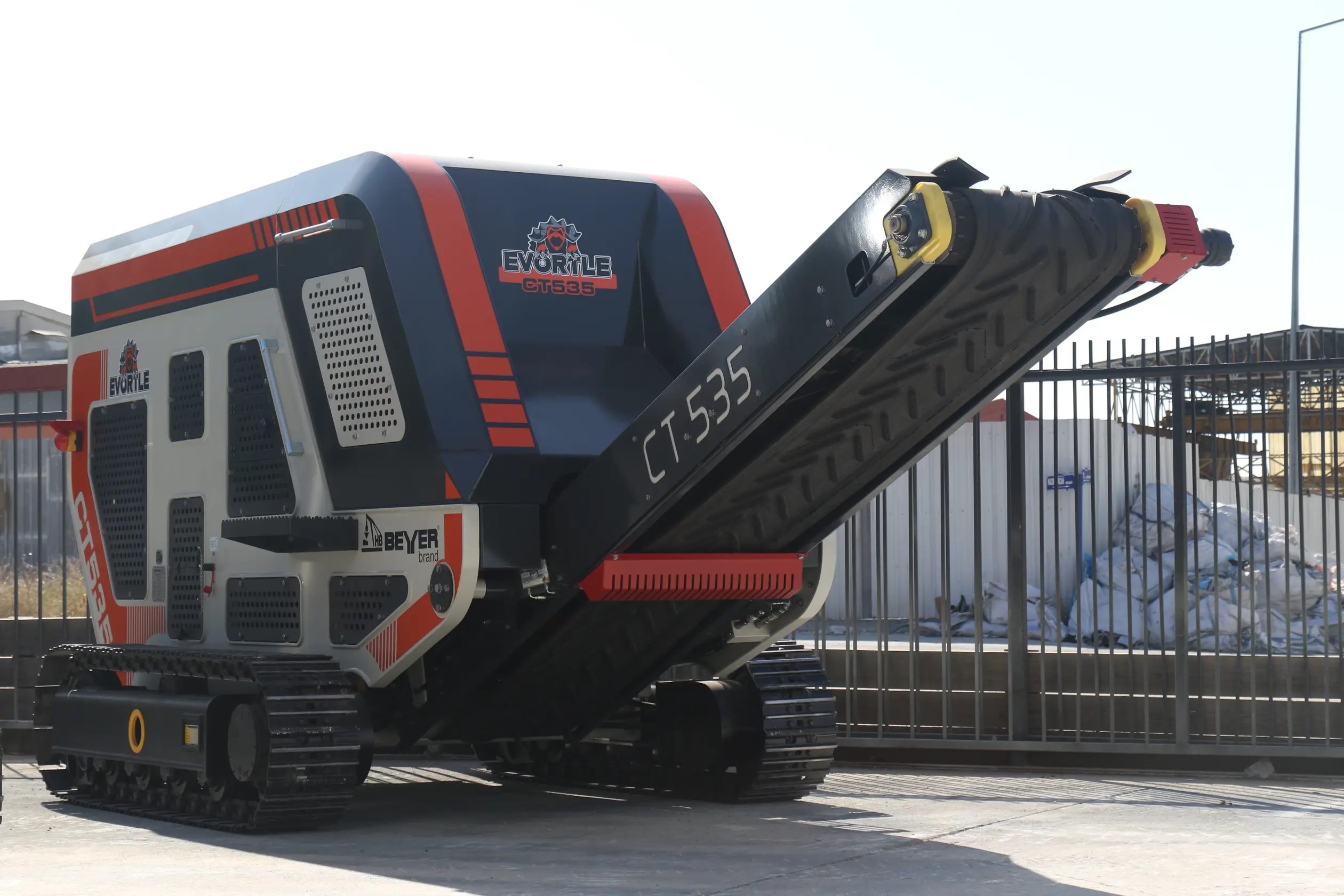
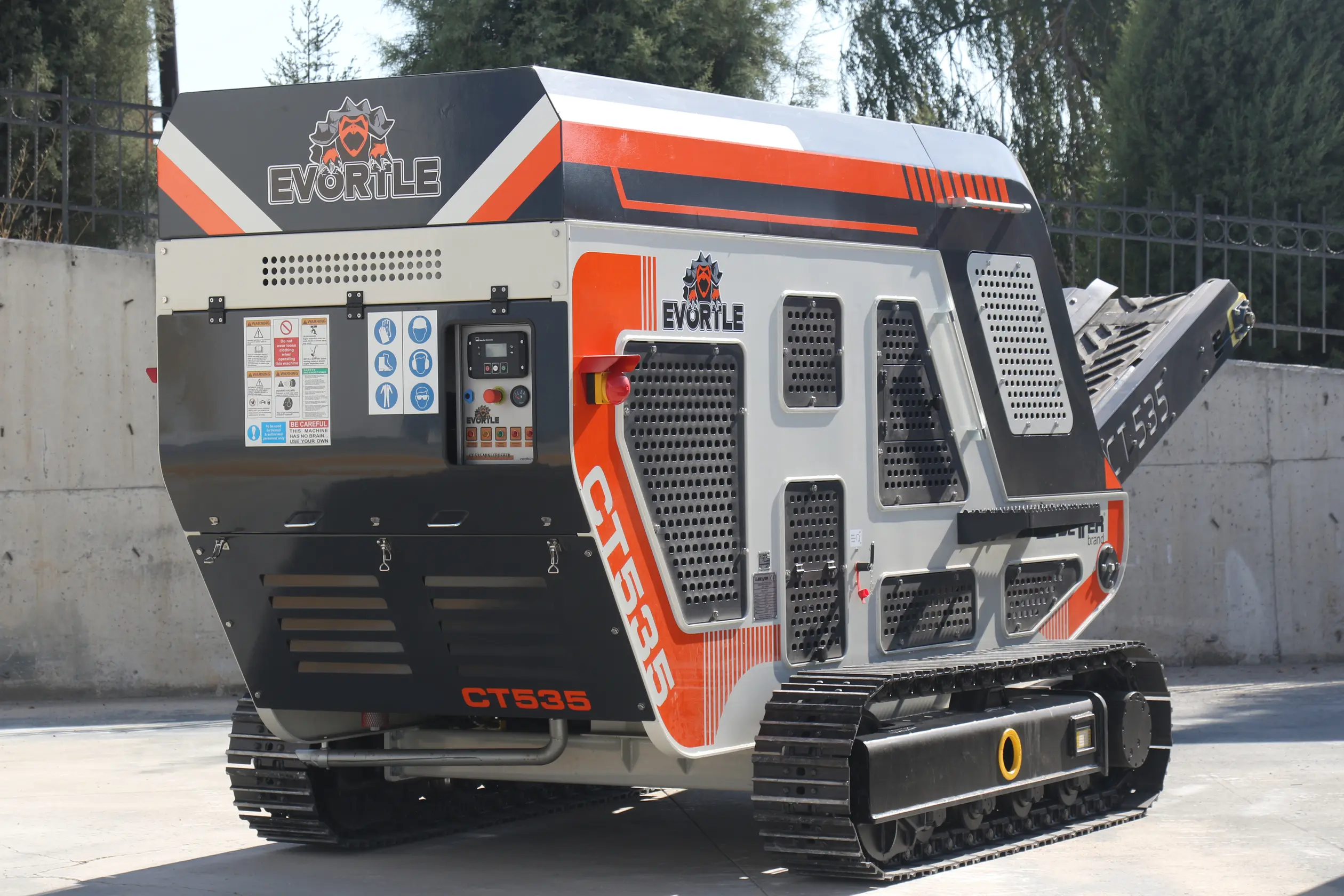
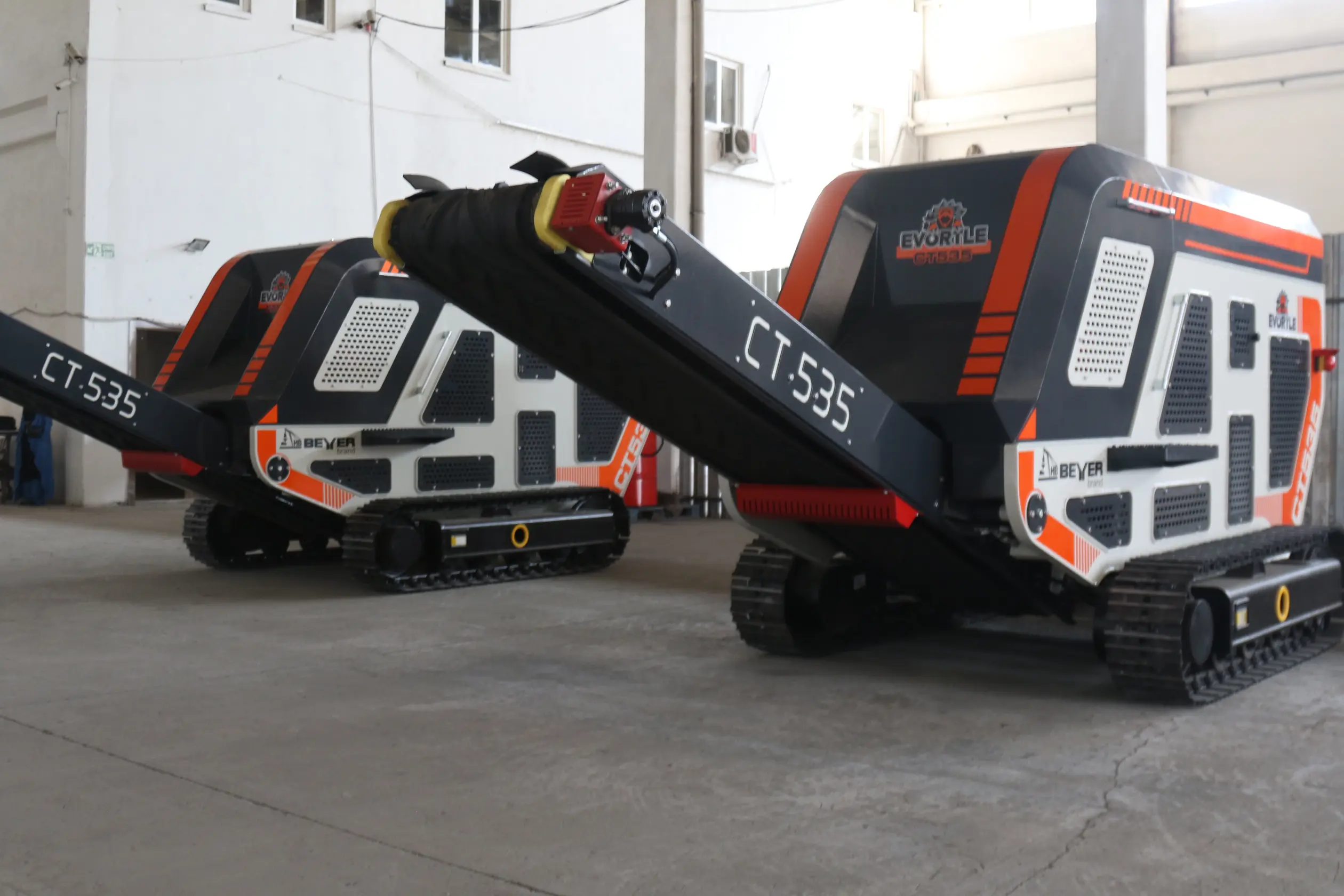
Built for contractors who crush 50 to 200 tons a day on site.
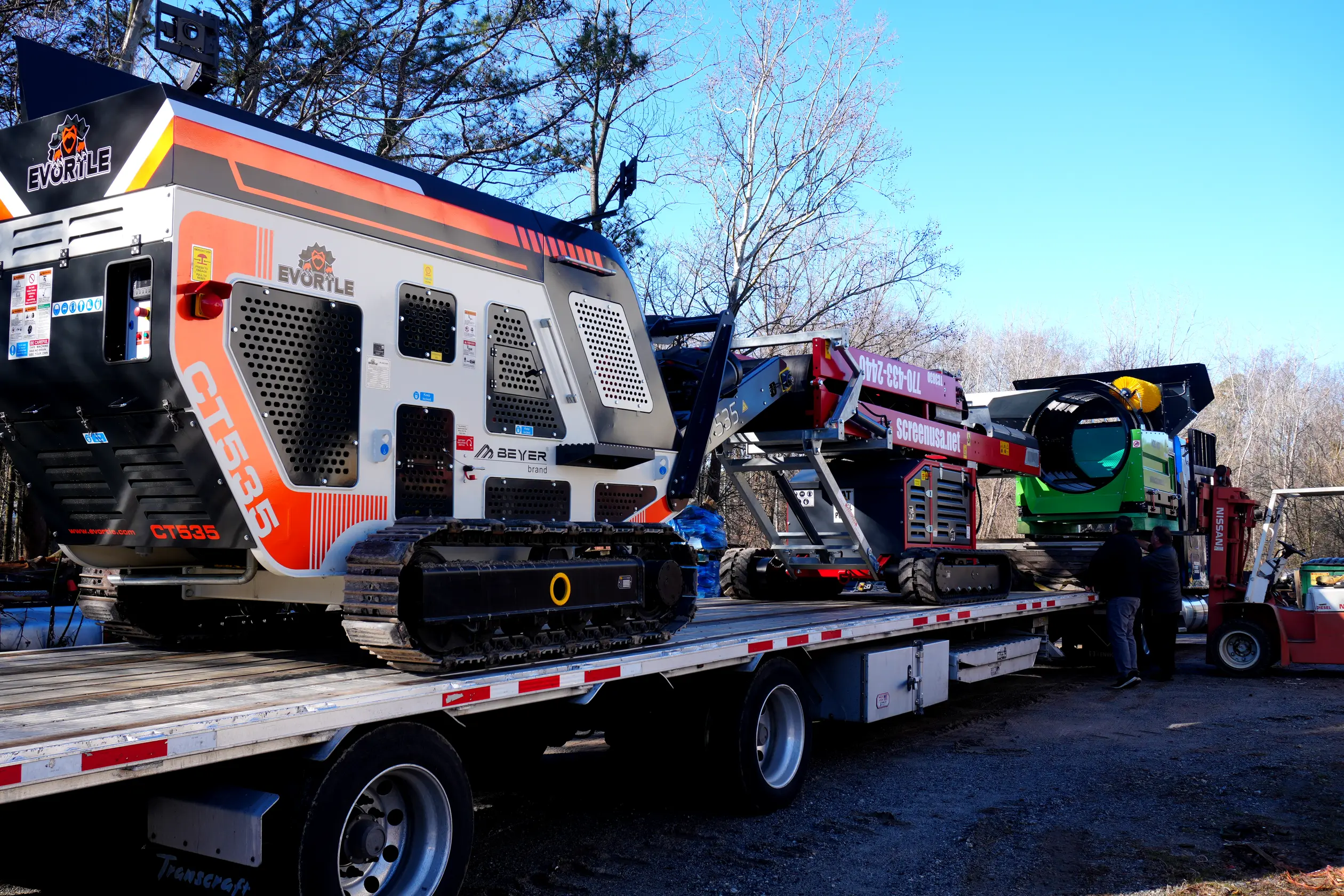
Track-mounted. Wireless remote. Fits on a standard lowboy. If you are processing concrete, brick, or masonry between job sites, this is the size class to look at.
“You have a pile of concrete. You need to process it on site. Not haul it out.”
The CT535 is for contractors who move between job sites and need a compact jaw crusher they can put on a trailer, run through a pile of concrete or brick, and be moving again by end of week.
It is not a stationary plant. It is not built for granite or hard rock. It is built for concrete recycling, brick demolition, and soft material reduction at 50 to 200 tons per day — which covers most of the work that drives a small to mid-size demolition or C&D operation.
Contractors running residential driveways, municipal sidewalk contracts, and small commercial demo jobs use it differently — not to crush one job in a day, but to accumulate the week’s material and process it in one run. The math still works. It works better.
What it costs you not to have one.
$33/ton
Average haul and tipping cost per ton of concrete waste
Based on $8/ton haul + $25/ton tipping fee
$3–5/ton
What you pay per ton when you process on site
The rest stays in your pocket.
$8–15/ton
What crusher run sells for as base material
Material you were paying to dispose of becomes sellable product.
Does the CT535 make sense for your operation?
Run the numbers. We will tell you straight.
Estimates are fine. If you are not sure what you pay, pull one hauling invoice and one landfill receipt — everything below comes off those two pieces of paper.
Enter your weekly tonnage, haul cost and tipping fee to run the numbers.
Count loads, not tons. A tandem dump runs 12–15 tons, a tri-axle 18–22. Broken concrete averages 1.3 tons per cubic yard, so a 20-yard container of slab is about 26 tons.
Haul cost per ton
Take a trucking invoice, subtract the tipping line, divide by the tons on the ticket. Hauling your own? Add fuel, driver hours and round-trip time. Most contractors land between $6 and $12.
Tipping fees per ton
The gate fee on your landfill or recycling receipt, trucking excluded. Billed per load? Divide by load weight. Clean concrete usually runs $18–$35; mixed C&D costs more.
What we assume
CT535 purchase price
$149,900
On-site operating cost
$4/ton
Working weeks per year
52
Cross magnet (optional)
+$7,000
What the CT535 processes.
Concrete — reinforced or plain
Brick and masonry
Soft rock and limestone
Demolition debris (minus wood, plastic, metal)
Output Product
CSS Setting
Throughput
Output Product3/4" road base
CSS Setting0.8"–1.2"
Throughput15 t/h
Output Product1.5"–2" base / #4 stone
CSS Setting1.5"–2.4"
Throughput20 t/h
Output ProductStructural fill / rip-rap
CSS Setting4"
Throughput30 t/h
Does not crush asphalt. For asphalt, you need an impact crusher.
Call to confirm
Current inventory and lead time
Pre-delivery inspection
Every machine inspected in-house before it ships
Warranty
Terms available through GrinderCrusherScreen — ask when you call
Since 1973
Screen USA has been sizing crushing equipment for 50+ years
Full specifications.
Engine
74 HP Hatz Tier 4 Diesel
Jaw Opening
20" × 14"
CSS Range
0.8" – 4" (20–100mm)
Hopper
1 cu.yd. (2'-3" × 6'-6")
Discharge Height
5'-11"
Discharge Conveyor
9'-10" L × 1'-6" W, herringbone belt
Transport Dimensions
18'-9" × 7'-1" × 8'-11"
Weight
14,330 lbs
Weight with magnet
15,831 lbs
Mobility
Track-mounted, wireless remote control
Optional cross magnet — $7,000 ($156,900 total)
Pulls rebar and metal from the discharge stream automatically. If you are crushing reinforced concrete, this pays for itself in downstream cleanup time on the first job.
What your operation looks like with it.
Fewer haul trips
Process on site. The material that was leaving on trucks stays on your job and becomes sellable base material.
Moves with you
Track-mounted and trailer-ready. One operator. No crane. Drive it off the lowboy, set up, and start crushing.
One phone number
Screen USA. We sized it, we sold it, we support it. Call the same number before and after the sale.
Video
See it run.
Playlist
3 Videos
0:16
0:16
0:16
On-Site Setup & Training
Boots on the ground. Wherever you are.
We come to your yard and work with you and your crew until the machine is running the way it should. Not a video link. Not a PDF. Not a scheduled webinar. Someone who knows the machine, standing next to it, on your job.
Crushing is not complicated, but doing it efficiently is. Feed rate, gap settings, when to close the jaw down and when to open it up, what a bearing sounds like before it goes. That knowledge is the difference between hitting the rated rate for the setting you are running and losing the morning to a bridged hopper.
None of that virtual BS.
Our competitors hand you a login and call it training. We show up.
Off the trailer, tracked into position, hoses and belt checked, first pile fed. Your site, your material, your crew watching.
Running it efficiently
Feed rate, hopper loading, and how to keep the jaw full without bridging or stalling. Most of the tonnage people leave on the table is here.
Gap settings and output
How to set the CSS for the product you are selling, and what changes when you tighten it. Same machine, three different products.
Daily maintenance
Grease points, fluid checks, belt tension, jaw plate wear. What to look at every morning and what can wait for the weekend.
Knowing what a problem sounds like
Wear patterns and failure modes straight from the engineers with design-level knowledge of this machine — so you catch it before it becomes a rebuild.
Your crew, not just your operator
Anyone who touches the machine gets trained. Turnover should not take your crushing knowledge with it.
Service & Support
Anyone can sell equipment. Supporting it is where we shine.
This is an industry built on crushing things. Things break. Downtime is a matter of when, not if — so the only question that matters is who picks up the phone and how fast the part ships.
Parts are stocked here. Diagnosis comes from an in-house manufacturer-trained engineer with design-level knowledge of the machine. No call centers, no ticket queues, no waiting on a time zone in Europe to wake up.
Parts in stock, stateside
Instead of a purchase order sent overseas and a three-week wait
An in-house engineer diagnoses it
Instead of a ticket queue and a support agent reading a manual
Same time zone, same phone number
Instead of waiting for an office in Europe to open
Before delivery
In-house pre-delivery inspection
Every machine is inspected at the Smyrna, GA facility by the same manufacturer-trained engineer who will train you on delivery day. Nothing is outsourced to a third-party shop.
Hydraulic pressure testing and fluid checks
Jaw alignment and gap adjustment verified
Wireless remote calibration and range test
Track operation and safety shutoff testing
Delivery day
Hands-on training on site
The engineer meets you at delivery and walks your crew through setup, operation and daily maintenance until they are confident running it.
Setup start to finish
Controls and wireless remote
Hydraulic gap adjustment
Daily inspection routine
After the sale
Engineer-level support for the life of the machine
Your local technician handles routine service. When something complex comes up, they work directly with the in-house engineer — design-level knowledge, not a script.
Direct line to manufacturer-trained engineers
National network of qualified mechanics
Parts stocked in Smyrna, GA — no overseas wait
One point of contact for parts, service and scheduling
Smyrna, GA
US headquarters and parts inventory
In-house engineer
Manufacturer-trained, not a call center
Nationwide
Network of insured field technicians
50+ years
Screen USA has been in equipment since 1973
Common Questions
My concrete has rebar in it. Is that a problem?
The CT535 handles reinforced concrete. The jaw crushes through rebar. The optional cross magnet ($7,000) pulls metal from the discharge belt so your output is clean. Most operators crushing demo concrete run the magnet.
Can I move this between job sites?
Yes. That is what it is built for. 18′-9″ long, 7′-1″ wide, under 9 feet tall — it loads onto a standard lowboy without a permit in most states. One operator can load, transport, and set up without additional equipment.
What size pieces can I feed into it?
The jaw opening is 20″ × 14″. Your feed material should not exceed 20 inches in width. If you are breaking slabs before feeding, plan for pieces your excavator can reliably produce under 20 inches.
How fine can it crush?
The CSS goes down to 0.8 inches. At that setting you are producing 3/4″ road base at about 15 tons per hour. For a sorted spec product finer than 3/4″, you need a screen or trommel downstream.
Can it handle asphalt?
No. Jaw crushers do not crush asphalt. Asphalt is sticky and soft — it gums up the chamber instead of fracturing. If you are processing asphalt or RAP, you need an impact crusher. Call us and we can point you in the right direction.
How does pricing work?
Call us or use the expert form on this page. We will confirm availability, talk through your operation, and give you a number. Financing options are available. The CT535 is sold through GrinderCrusherScreen.com.
Need more capacity?
CT850
CT850
150 HP | 32″×20″ Jaw | 65–130 t/h
For crews running more than 500 tons a week, feeding pieces over 20 inches, or crushing hard rock.